
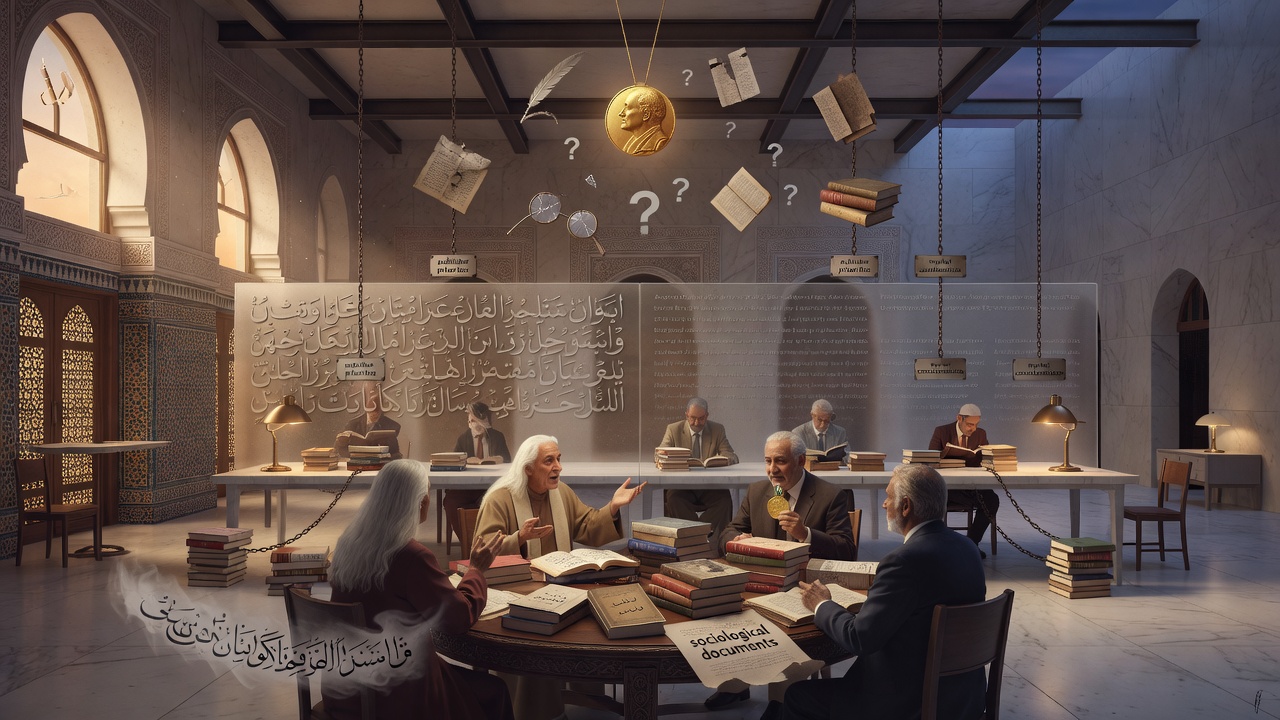
Each autumn, Arab intellectuals revisit the same question: whether Arabic literature can win the Nobel Prize, and whether the committee even considers writing in Arabic. The debate often turns inward, toward self-criticism and the search for a single worthy name. This essay argues that the real obstacles lie elsewhere, in language access, translation, and the narrow ways Arab writing has been read and judged.
A recurring debate and its limits
The annual discussion tends to center on a handful of names, with the poet and thinker Adonis frequently cited as the figure closest to the prize. Since Naguib Mahfouz won in 1988, the hope of a second Arab laureate has repeatedly faded, and each year's disappointment reignites the same argument. Much of that commentary carries a tone of self-reproach, as if Arab writers had stopped producing poetry, fiction, drama, criticism, or scholarship. The output of the region's writers and universities contradicts that impression.
The Nobel goes to one writer a year, and its history includes many major authors who never received it. Treating the prize as a measure of a literature's total worth misreads both the award and the field it recognizes.
The language barrier and the problem of translation
The Swedish Academy reads primarily in English, French, Spanish, German, and Swedish. Arabic has more speakers than several of those languages, and its global reach continues to grow through religious, academic, diplomatic, and economic study. A committee that cannot readily read the language faces a structural problem that has little to do with the quality of the writing itself.
Translation compounds the difficulty. Relatively little Arabic literature is translated into the committee's languages, and the selection of what reaches them depends heavily on factors beyond literary merit, including publisher priorities and market considerations. Western publishing and academic institutions have also tended to read Arabic texts mainly as sociological documents, which can obscure their formal and artistic achievements.
Political conditions and the nature of literary expression
Some commentators argue that authoritarian politics, economic stagnation, and social tensions reduce the chances of an Arab laureate. Literary history offers a more complicated picture. Writers working under repression have often developed indirect, layered, and allusive forms of expression, and many of the most important literatures of Latin America, Asia, and Africa emerged under oppressive regimes. Judging writers by the conditions around them risks penalizing them for circumstances they did not choose.
Rethinking what the prize recognizes
The Nobel is awarded for literature in a broad sense, and recent laureates have worked across poetry, fiction, drama, nonfiction, criticism, translation, and other forms. Many Arab critics still treat scholarship and creative writing as separate spheres, which narrows the range of candidates they consider. Recognizing the breadth of the award would widen the conversation and shift attention from a single name toward the larger, more varied body of work the region actually produces.