
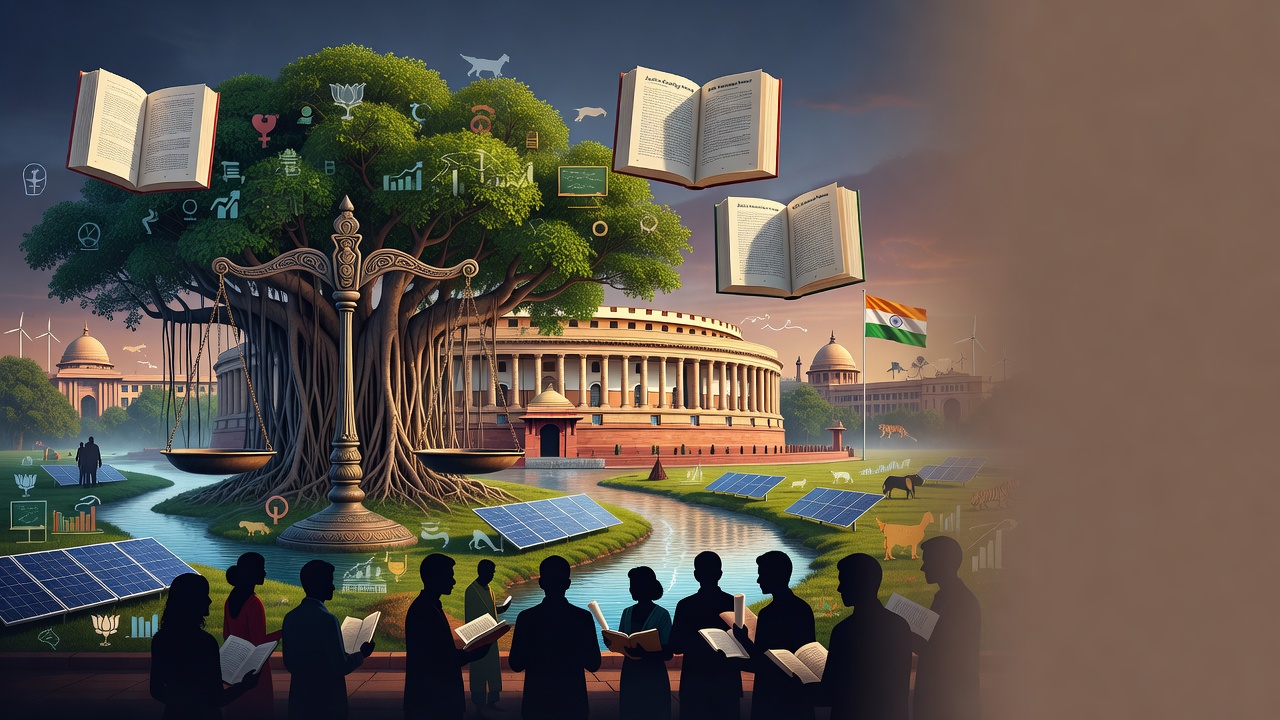
A new Routledge book co-edited by Rekha Datta, the Freed Endowed Chair in Social Sciences and a professor in the Department of Political Science, examines India's democratic system through the twin lenses of justice and sustainability. The volume, released in 2026, was produced with Zaad Mahmood of Presidency University and Sanjeeb Mukherjee of Jadavpur University. It is part of the publisher's Routledge Studies in South Asian Politics series.
A Two-Part Framework for Reading Indian Democracy
According to the source material, the book treats justice and sustainability as joint premises for assessing how India's democratic political system works. Rather than treating environmental concerns as a separate policy track, the contributors argue that ecological questions are bound up with social and political ones. That approach is presented as a challenge to technocratic accounts of sustainability that detach the environment from society.
How Parties, Identity and Policy Fit In
The chapters, as described, look at how political parties, identity, gender, education, economic policy and foreign policy intersect with justice and sustainable development goals. This breadth is meant to show where democratic institutions succeed or strain under pressure. The editors frame the work as a nuanced account of the challenges facing India's democratic present and the strengths needed to stabilize it.
The Argument About Governance and Citizenship
The book's central claim is that the trajectory of Indian democracy, and the durability of democratic governance itself, depends on whether the state can deliver social, economic and ecological justice to all citizens. That is an argument about conditions rather than a forecast with a fixed outcome. Readers interested in South Asian politics will find it a scholarly contribution rather than a verdict on any single government or policy.