
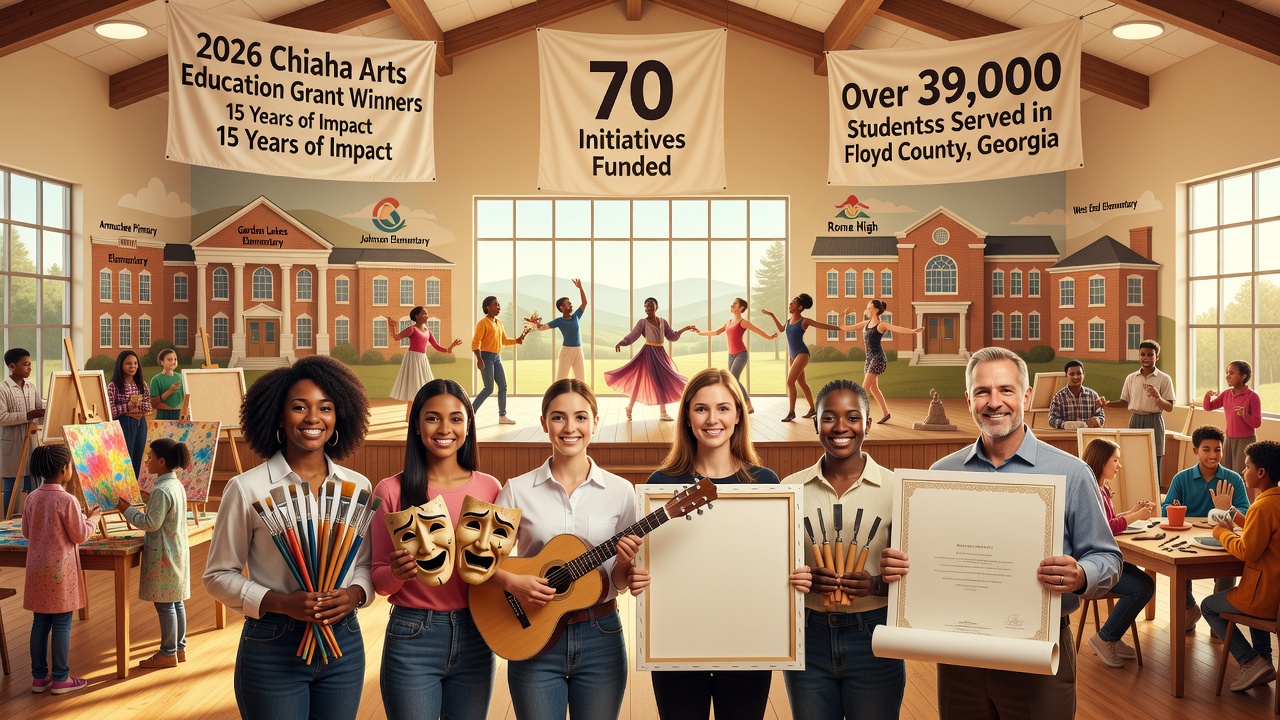
The Chiaha Arts Guild has named five schools and educators as recipients of the 2026 Chiaha Arts Education Grant, drawn from both the Rome City and Floyd County school systems in Georgia. The announcement also marks the program's 15th year, with 70 arts education initiatives funded to date and more than 39,000 students served in Rome and Floyd County.
The 2026 grantees
This year's awards go to Armuchee Primary School, led by Christi Williams; Garden Lakes Elementary School, led by Emily Threlkeld; Johnson Elementary School, led by Jennifer Pullen; Rome High Theatre, led by Alexis Tyson; and West End Elementary School, led by Dr. Sam Simon. The guild says the recipients span a range of creative disciplines, and the mix of elementary programs and a high school theatre reflects the grant's focus on PreK-12 students.
The source material does not describe the individual projects in detail, so the specific art forms, budgets and student numbers for each award are not available here. Readers looking for those details would need the guild's own grant announcements or the schools themselves.
What the grant is designed to do
The annual program funds projects that improve and expand visual and performing arts education for PreK-12 students in Floyd County, Georgia. Its aim is less about one-time events than about building lasting access, so that schools without strong arts resources can still offer students sustained instruction and performance opportunities.
Chris Davidson, Chiaha's president and the grant program director, said the guild was impressed by the quantity and quality of applications and that it wished it had resources to fund them all. That remark points to the program's central constraint: demand from local educators exceeds available funding every year, and only five projects can be supported in 2026.
Practical implications and limits
For students and families, the award means that five schools will have dedicated support for arts work over the coming grant period. For the wider community, the figures of 70 funded initiatives and roughly 39,000 students served show a sustained local investment across 15 years, though the source does not break down how many students each project reaches or how outcomes are measured.
Because the announcement is a grant selection notice rather than an evaluation, it does not show whether past projects achieved their goals. Anyone assessing the program's impact would need follow-up reporting, project-level results or independent review. Further information about the grant and other Chiaha programming is available at chiaha.org.